.png)
Email Now: hello@quillmarketing.com

Email Now: hello@quillmarketing.com
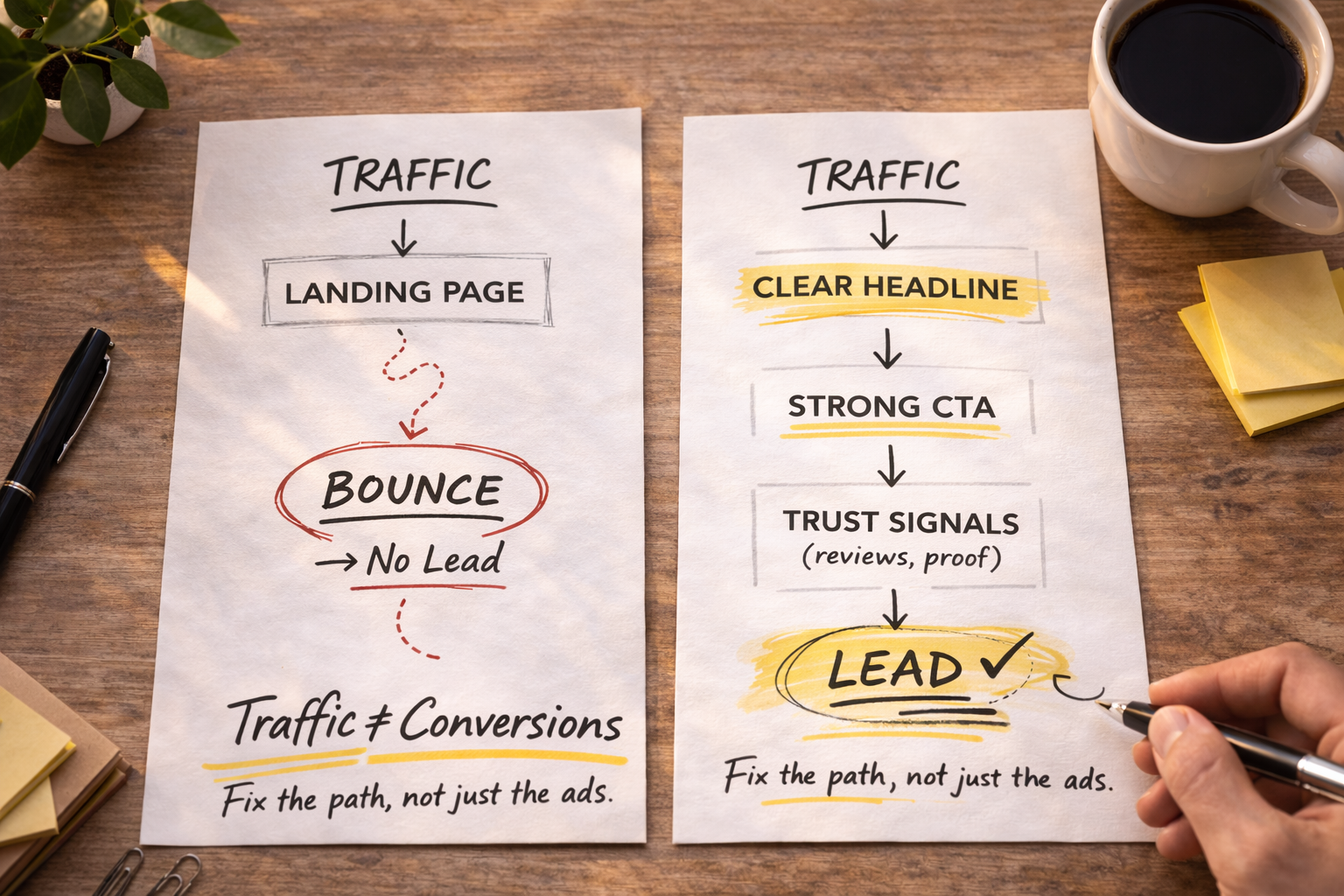
It is a common frustration for many business owners. You check your analytics and see the numbers climbing. People are clicking your ads or finding you through search engines. However, your inbox remains empty and your phone stays silent. Having website traffic but no leads feels like throwing a party where everyone walks in the front door and immediately exits through the back.
In this article, you will learn why visitors might be leaving without taking action. We will explore how to identify friction on your pages and how to align your content with user intent. By the end, you will have a clear roadmap to transform those passive visitors into active customers.
High traffic is a vanity metric if it does not result in revenue. Often, the issue begins with the type of audience you attract. If your SEO or ad strategy targets broad terms, you might reach people who are just browsing rather than those who are ready to buy. When you experience website traffic but no leads, it usually suggests a "mismatch" between what the user expected and what they found.
For instance, if someone searches for "best running shoes" and lands on a page that only discusses the history of rubber, they will leave. You must ensure your content matches the searcher's goal. If your keywords are too generic, you will see a high bounce rate. Analyzing your search terms in Google Search Console can help you see if you are attracting the right crowd or just a crowd.
If your audience is relevant but still not reaching out, the problem likely lies in the user experience. A website not converting often suffers from technical or design flaws that frustrate the visitor. Page speed is a primary culprit. In a world of instant gratification, a delay of even three seconds can lose a lead forever.
Mobile responsiveness is another critical factor. Most users now browse on their phones. If your buttons are too small to click or your text is hard to read on a mobile device, users will abandon ship. You should regularly test your site on various devices to ensure the journey is smooth. If the path to a lead form is blocked by popups or slow loading times, your conversion rate will suffer.
Your landing page is the "closer" in your sales process. If you have a landing page not converting, it usually lacks a clear value proposition. Within seconds, a visitor needs to know what you offer, how it benefits them, and what to do next. If they have to hunt for this information, they will find a competitor who makes it easier.
Many pages fail because they focus on features instead of benefits. Do not just list what your product does; explain how it solves the customer's specific problem. Trust signals also play a massive role here. If your page looks outdated or lacks testimonials and secure payment badges, visitors will be hesitant to share their contact information.
A low conversion rate website is often a symptom of too many choices. When you give users ten different things to click on, they often click on nothing at all. This phenomenon is known as "analysis paralysis." To fix this, you should simplify your navigation and focus each page on one primary goal.
Each service page should lead toward a single call to action. Whether that is a contact form, a phone call, or a newsletter signup, make it obvious. Use contrasting colors for your buttons so they stand out from the background. By reducing distractions, you guide the user's eyes toward the destination you want them to reach.
It is painful to watch your budget disappear when you see why Google Ads are not getting leads. If you are paying for clicks but seeing zero return, there is likely a "scent" problem. The "message scent" is the continuity between your ad copy and your landing page. If your ad promises a "50% discount" but the landing page mentions full price, the user feels misled.
Another reason could be the keyword match types. Broad match keywords can trigger your ads for irrelevant searches, wasting your money on people who have no intention of hiring you. Refine your keyword list and use negative keywords to filter out junk traffic. This ensures your budget is spent on high-intent users who are more likely to convert.
To improve landing page conversion rate, you must embrace the "less is more" philosophy. Start by shortening your forms. Every extra field you add to a lead form decreases the likelihood of someone finishing it. Only ask for the essential information you need to follow up.
Additionally, use strong, active headers. Instead of saying "Our Services," try "Grow Your Revenue with Our Expert Solutions." This shifts the focus to the user’s success. Including a "lead magnet," such as a free guide or a consultation, can also entice users who are not quite ready to buy but are willing to trade their email address for valuable information.
Effective conversion rate optimization for lead generation involves constant testing. You should never assume your first design is the best one. A/B testing allows you to compare two versions of a page to see which performs better. You might test different headlines, button colors, or even the placement of your contact form.
Small changes often lead to significant results. For example, moving a testimonial higher up the page can build trust earlier in the user's journey. Use heatmaps to see where users are clicking and where they are getting stuck. This data-driven approach removes the guesswork from your marketing strategy.
When you have significant website traffic but no leads, you must also look at your internal linking and site structure. Are you leading people from your blog posts to your service pages? If a visitor reads an informative article but has no clear path to your services, they will simply leave after finishing the post.
Ensure every blog post ends with a logical next step. If the post is about SEO, the call to action should be an invitation for an SEO audit. This creates a cohesive journey that turns a casual reader into a qualified lead. If you leave the user to find the "Contact Us" page on their own, you are losing potential business.
To increase lead conversion rate, you need to build immediate authority. Video content is an excellent tool for this. A short video explaining your process or showing a success story can build a connection faster than text alone. It humanizes your brand and makes you appear more approachable.
Also, consider the "timing" of your offers. Not everyone is ready to sign a contract on their first visit. Using "exit intent" popups can capture a lead just as they are about to leave. Offer them something of value, like a checklist or a discount code, to stay top of mind. This helps you nurture the relationship over time.
If your cost per lead is too high, it often means you are bidding on the wrong terms or your conversion rate is too low. By improving the efficiency of your pages, you naturally lower your acquisition costs. A site that converts at 5% is twice as profitable as one that converts at 2.5%, even with the same ad spend.
Focus on your high-performing pages first. If you have one page that consistently generates leads, study why it works and apply those lessons to the rest of your site. This focused effort ensures you are maximizing the value of every dollar spent on traffic.
Seeing website traffic but no leads is a signal that your digital storefront needs a renovation. Whether the issue is a lack of trust, slow page speeds, or a confusing layout, the solutions are within your reach. By prioritizing the user experience and clarifying your message, you can stop the "leaky bucket" in your marketing funnel.
Are you ready to turn your visitors into customers? Start by picking one page on your site today and simplifying the call to action. If you need professional help to refine your strategy, Quill Marketing is here to guide you.
