.png)
Email Now: hello@quillmarketing.com

Email Now: hello@quillmarketing.com
TL;DR: A modern search strategy treats SEO, PPC, and AI search visibility as one system instead of three competing line items. SEO builds long-term authority, PPC captures demand right now, and AI platforms cite trusted sources when they answer questions. Brands that integrate all three build a compounding growth engine; brands that silo them leave growth on the table.
For years, the search conversation for marketing teams came down to one budget question: SEO or PPC? Organic search promised durable traffic that compounds over time. Paid search delivered visibility and leads this week. Most companies picked a lane, or split the budget and ran the two as separate programs owned by separate people.
That framing made sense when "search" meant a Google results page with ten blue links and a few ads on top. However, it no longer describes how people find businesses. Today, a potential customer might discover your brand through an organic listing, a paid ad, a Google AI Overview, or an answer generated inside ChatGPT, Gemini, or Perplexity, and increasingly, these platforms answer the question directly, drawing on the sources they consider most credible.
That shift changes the job. Ranking well is still necessary; it just isn't sufficient. Brands now compete across three connected layers of search: SEO (organic visibility and authority), PPC (paid demand capture), and AI search visibility (citations inside AI-generated answers). The companies winning search in 2026 aren't choosing between these channels. They're building a unified search strategy where each layer strengthens the other two.
A modern search strategy integrates SEO, PPC, and AI search visibility so a brand can be found wherever people search, whether that’s organic results, paid placements, and AI-generated answers. Instead of running each channel as its own program with its own goals, an integrated search strategy uses each one to feed the others: paid data informs organic content, organic authority earns AI citations, and AI visibility lifts branded demand across the board.
Search is no longer a single funnel where users scroll one results page and click a link. It's a set of overlapping discovery surfaces, each with different strengths.
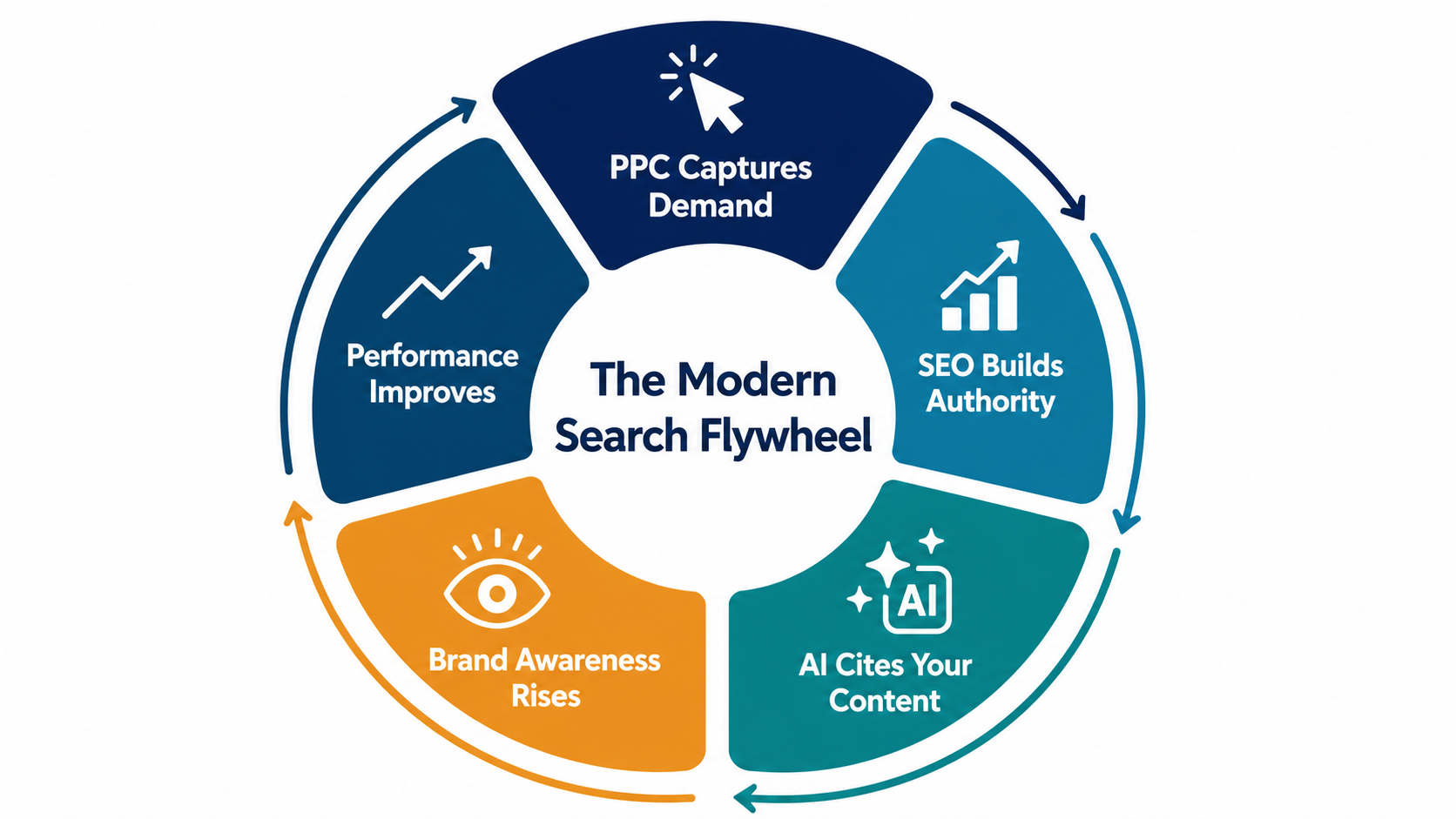
Managed together, the three behave less like a list of channels and more like a loop: SEO content becomes the source material AI systems reference, PPC reveals which keywords actually convert, and AI citations raise the brand awareness that later shows up as branded searches and stronger ad performance.
Search engine optimization is still the backbone of modern search marketing, because it's the layer that builds assets you own. A strong SEO program produces authoritative content, earned backlinks and brand mentions, clean site architecture, and genuine topical authority. These assets keep generating traffic long after the work is done.
What's changed is what those assets are for. Historically, the goal was a first-page ranking. Today, the same high-quality content determines whether your brand appears in featured snippets, AI Overviews, and the answers AI tools generate. Search engines and AI systems are looking for the same thing: trusted sources with clear, demonstrated expertise. That's why consistent, well-structured content marketing has quietly become an AI visibility strategy, not just a rankings play.
While SEO builds authority over time, paid advertising captures demand immediately: competitive keywords on day one and new offers tested in weeks instead of quarters. But the most strategic value of PPC isn't the traffic. It's the behavioral data: which keywords convert, which headlines earn clicks, which landing pages produce revenue. That intelligence is expensive to guess at and cheap to measure.
It's also getting more expensive to waste. WordStream's latest Google Ads benchmarks put the average cost per click at $5.42, more than double the $2.32 average of a decade ago. Rising CPCs are exactly why smart teams treat PPC as a testing environment: a keyword that converts profitably in paid campaigns is a proven topic for SEO content, so organic investment targets demand you've already validated instead of demand you hope exists.
The biggest shift in search is the rise of AI-powered answers. ChatGPT alone passed 900 million weekly users in February 2026, per OpenAI, and Semrush's analysis of 10 million keywords found Google's AI Overviews appearing on as many as one in four queries at their 2025 peak. And these are expanding into commercial searches. These systems synthesize multiple sources into a single response rather than listing websites.
For users, that means faster research. For brands, it means a new kind of competition: instead of competing only for rankings, you're competing to be a source AI systems trust and cite. The signals will look familiar to anyone who has done serious SEO, with authoritative content, consistent brand mentions across the web, structured information, and a trusted domain, but the emphasis shifts toward clear explanations, citable data, and corroboration from third-party sites. This discipline, often called generative engine optimization (GEO) or AI search optimization, is quickly becoming its own practice area alongside traditional SEO.
Plenty of organizations still run these as separate initiatives with separate owners and scorecards. Each may perform adequately alone, but the real returns come from the feedback loops between them.
PPC data sharpens SEO. Paid campaigns reveal within weeks which keywords drive conversions, de-risking organic investment and keeping it aligned with real customer demand.
SEO content earns AI citations. Articles that explain topics clearly, provide data, and demonstrate expertise are exactly what AI systems reference when generating answers.
AI visibility builds branded demand. When AI platforms present a brand as a trusted source, people search for it by name. Branded search rises, organic click-through improves, and paid campaigns convert better because the audience already recognizes you.
The clearest way to picture an integrated strategy is as a flywheel, where every turn makes the next one easier.
Isolated channels produce linear results. A flywheel produces compounding ones.
Treating SEO and PPC as budget rivals. The channels are force multipliers for each other. Framing them as competitors guarantees you'll underfund the loop between them.
Ignoring AI search visibility. AI answers are already shaping how buyers discover options. Waiting until competitors are the cited sources means starting from behind.
Quitting SEO before it compounds. Organic authority takes months of consistent investment. Abandoning it early forfeits the payoff right before it arrives.
Chasing rankings instead of authority. Search engines and AI systems both reward demonstrated expertise. Keyword tactics without substance don't survive contact with modern search.
SEO improves organic rankings through content, technical optimization, and authority building; results take longer but compound. PPC pays for placement on specific keywords; results are immediate but stop when spend stops.
PPC generates leads faster, while SEO delivers sustainable traffic at a lower acquisition cost over time. For most growing brands the honest answer is both, sequenced so paid data informs organic investment.
AI tools assemble answers from sources they judge credible, and strong SEO makes your content one of those sources. Clear structure, demonstrated expertise, and consistent brand mentions increase the odds your brand appears in AI-generated responses.
AI search optimization, often called generative engine optimization, or GEO, is the practice of earning visibility inside AI-generated answers on platforms like ChatGPT, Perplexity, and Google AI Overviews. It builds on SEO fundamentals and adds emphasis on structured content, citable data, and brand mentions across third-party sources.
Search has outgrown the SEO-versus-PPC debate. The goal is no longer just to rank well; it's to become the source that search engines and AI systems rely on, and that only happens when your channels reinforce each other instead of competing for budget.
That's what we build at Quill Marketing: integrated search strategies that combine SEO, paid search, and AI search visibility into one growth engine. It’s strategy through execution, measured in leads. If you're planning your next phase of growth, the question isn't which channel to invest in. It's how to make them work together.
Book a strategy call and let's map your flywheel.