.png)
Email Now: hello@quillmarketing.com

Email Now: hello@quillmarketing.com
Most businesses do not struggle because they have nothing worth saying.
Their teams understand their customers. Their leaders have valuable industry knowledge. Their salespeople hear the same questions and objections every week. The raw material for useful content already exists.
The challenge is turning that knowledge into a consistent marketing program that attracts the right audience, supports the sales process, and contributes to growth.
That is the role of a content marketing agency—but not every agency approaches the work in the same way.
Some agencies primarily produce deliverables. Give them a topic, and they will write an article. Others begin further upstream by identifying what the business should communicate, which audiences it needs to reach, how content supports its larger marketing strategy, and how performance will be measured.
Understanding that distinction can help you decide whether you need additional content production or a strategic marketing partner.
A content marketing agency helps businesses plan, create, distribute, and improve content intended to attract and convert a defined audience.
Depending on the company’s goals, that content may include:
Those are the visible deliverables. The more important work happens behind them.
An effective agency determines which content is worth creating, why it matters to the audience, how it supports the buyer’s journey, and what the reader should understand or do next.
At Quill Marketing, content marketing is not treated as an isolated publishing exercise. It is connected to search demand, buyer intent, brand positioning, conversion opportunities, and the company’s broader growth goals.
That means the objective is not simply to produce more material. It is to create content that performs a clear job within the marketing system.
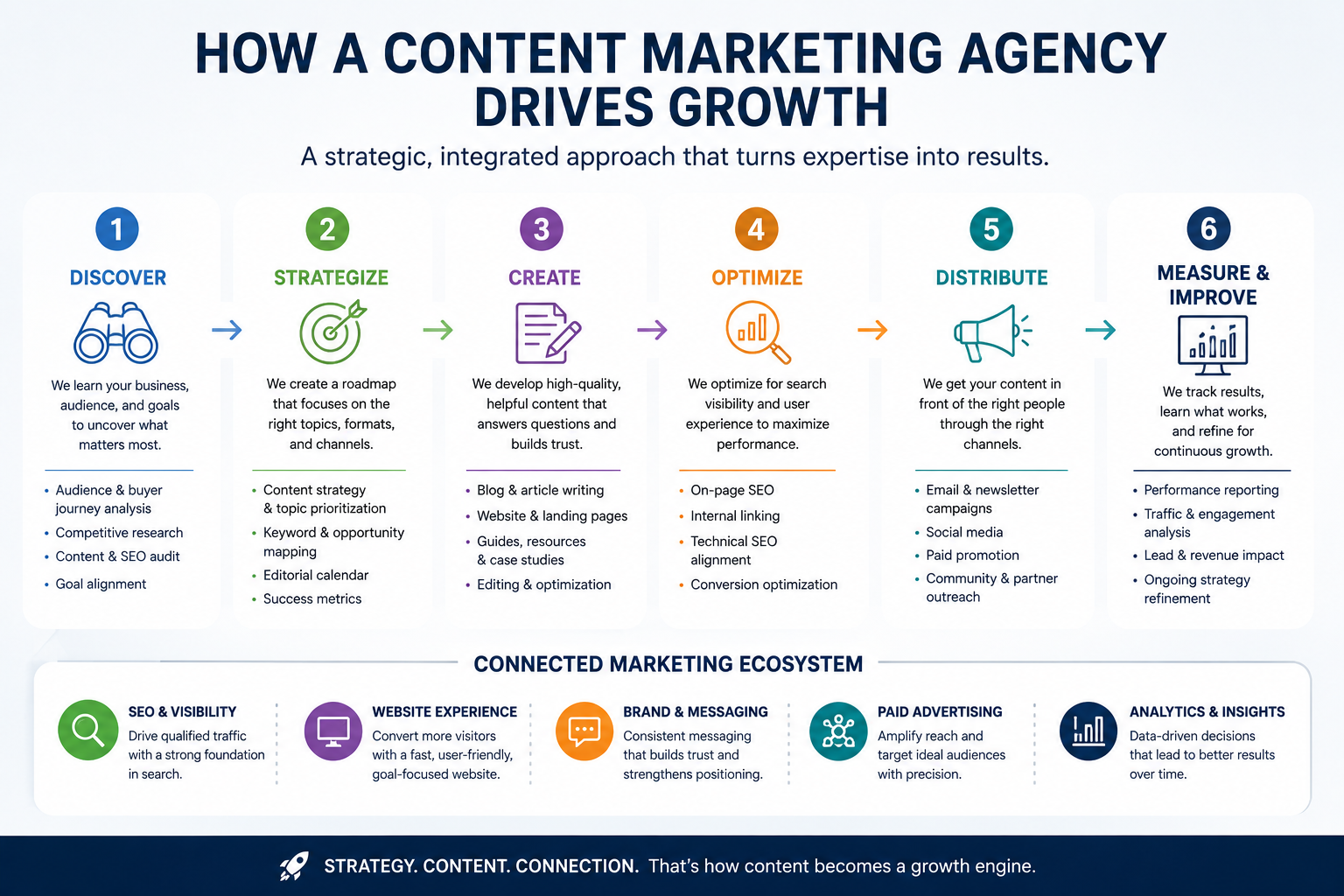
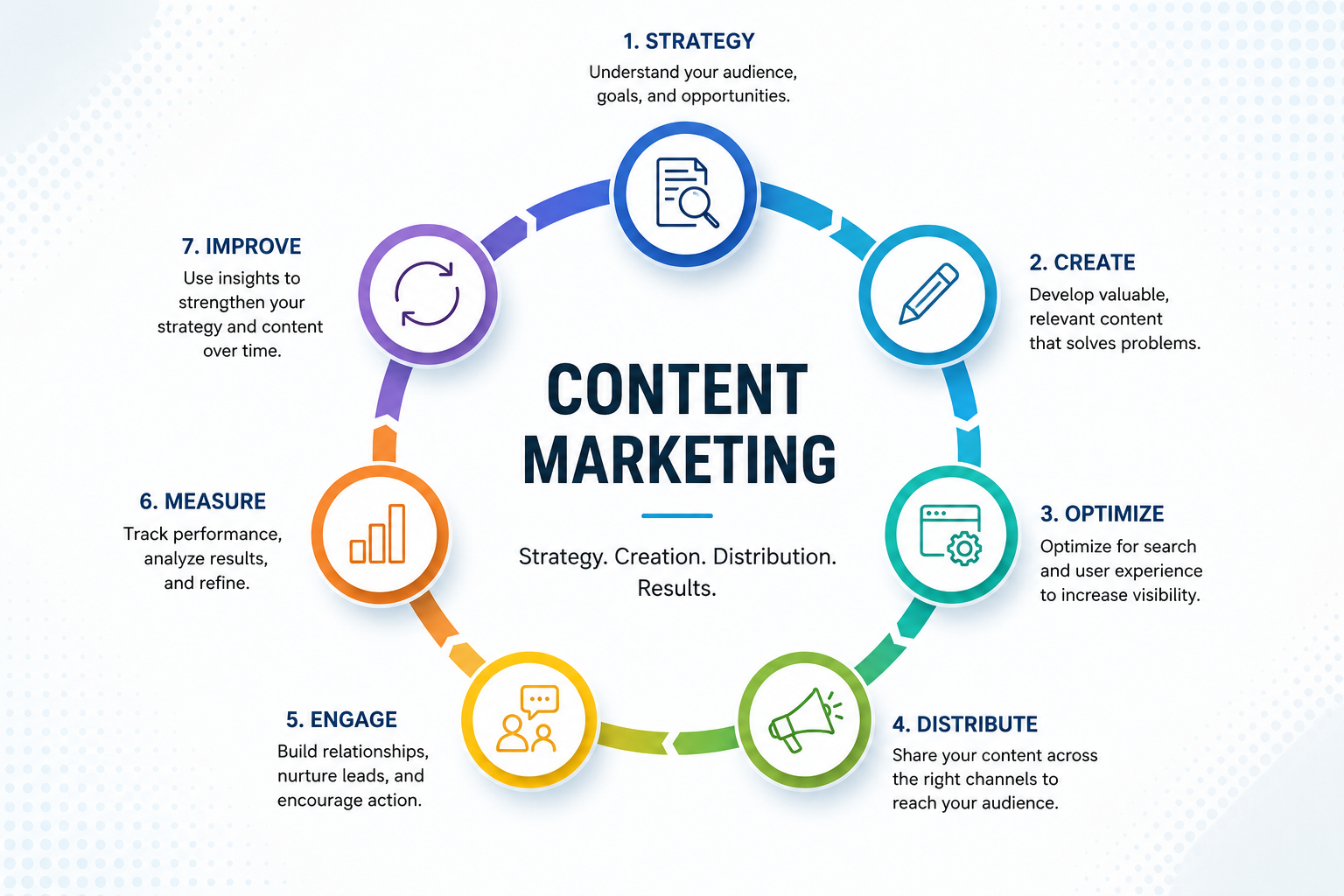
The work usually includes several interconnected responsibilities.
Before selecting topics or building an editorial calendar, an agency should understand what the business is trying to accomplish.
Is the goal to enter a new market? Generate more qualified leads? Improve visibility for a high-value service? Strengthen credibility in a complex industry? Support a long sales cycle? Help prospective customers understand why the company is different?
The answers should influence what gets created.
A business seeking more local service inquiries needs a different content strategy from a B2B firm trying to educate multiple decision-makers over a six-month buying process. A company introducing a new service has different priorities from one trying to defend its position in a competitive market.
Without that context, a content calendar can become a list of disconnected topics that generate activity without creating meaningful progress.
Useful content begins with an accurate understanding of the people the business wants to reach.
A content marketing agency may examine:
This research helps the agency create material based on genuine audience needs rather than internal assumptions.
It also improves the usefulness of the finished content. An article written around a real customer question can support organic search, give the sales team a resource to share, and help a prospective buyer make a more informed decision.
A content strategy establishes what the company will communicate, who it is trying to reach, which channels it will use, and how individual assets will support broader objectives.
That may involve:
The result should be more than a spreadsheet of article titles. It should explain how the proposed work connects to the company’s visibility, authority, lead generation, and sales goals.
Many businesses already possess the knowledge their audience needs. The problem is that the knowledge is scattered across leadership conversations, sales calls, internal documents, and the minds of busy subject-matter experts.
A content agency should have a process for extracting and organizing that expertise.
Depending on the engagement, that may include interviews, questionnaires, research sessions, call reviews, or collaboration with sales and service teams. The agency then turns those insights into clear material without expecting internal experts to become professional writers.
This step is particularly important in professional services, technical fields, healthcare, legal services, B2B industries, and other trust-based markets. Generic research can explain a topic. Firsthand expertise gives the content credibility, specificity, and a point of view.
Once the strategy and source material are established, the agency develops the content itself.
Good content creation involves more than producing grammatically correct sentences. The writer and editor must consider:
The work should sound like the company—not like a generic agency article that could be published under any brand’s name.
That is one reason brand strategy and messaging matter so much. When a business has not clearly defined who it serves, what it offers, and why customers should choose it, its content tends to become vague or interchangeable.
Clear positioning gives every article, landing page, email, and campaign a consistent foundation.
Content and search engine optimization are closely connected, but they are not synonymous.
Content gives a business opportunities to address relevant questions, demonstrate authority, and appear for searches related to its services. SEO helps ensure that search engines can understand, index, and appropriately rank that material.
An integrated SEO and visibility strategy may include:
The goal is not to insert a target phrase as many times as possible. It is to create the strongest available resource for an appropriate search while making the page easy for both readers and search engines to understand.
Search behavior is also expanding beyond a traditional list of blue links. Buyers increasingly use generative platforms to research problems, compare providers, and ask natural-language questions. Strong AI search optimization is built on many of the same fundamentals: clearly structured content, recognizable expertise, topical authority, credible brand signals, and technically sound pages.
Traffic is only useful when the website gives visitors a clear path forward.
An article may successfully attract the right reader but still fail to generate business if the next step is unclear, the service pages are unconvincing, or the website creates unnecessary friction.
That is why content strategy should account for what happens after someone arrives.
Relevant next steps might include:
The path should make sense in context. A reader beginning to research a problem may not be ready to schedule a sales call immediately. A reader comparing providers may need proof, process information, or answers to common objections.
Content works best when it is supported by a website designed around clarity and conversion. The site is the hub connecting search visibility, brand messaging, content, campaigns, and lead generation. If it is slow, confusing, or difficult to navigate, even strong content will have limited impact.
A strategic agency does not necessarily treat every piece of content as a one-time publication.
A detailed guide might also provide material for:
This does not mean repeating the same message everywhere without adaptation. Each channel has a different audience context and purpose.
The objective is to make better use of the company’s ideas. One meaningful piece of research or subject-matter input can often support several well-planned assets.
Content strategy should evolve based on evidence.
Depending on the goals of the engagement, useful measurements may include:
Not every article will directly produce a lead, and last-click attribution rarely captures content’s full role. A prospective customer may encounter a company through search, read several resources, leave, return through a branded search, and finally make contact after seeing a paid advertisement.
A capable agency looks at the wider customer journey and uses the available data to improve future decisions.
A content vendor is often hired to complete a defined assignment. The client determines what needs to be created, and the vendor produces it.
That arrangement can work well when a business already has:
The business knows what it needs and primarily requires additional production capacity.
A strategic content marketing agency takes responsibility for more of the decision-making. It helps determine what should be created, how content supports the broader marketing plan, where gaps exist, and how the work should be prioritized.
The difference is not that one model is universally better. It is a matter of what the business actually needs.
Hiring a production partner and expecting strategic leadership usually creates frustration. Hiring a strategic agency when the company only needs a few clearly defined assets may create unnecessary complexity.
Quill Marketing began as a white-label content partner, producing SEO-driven content behind the scenes for agencies and growing businesses.
That foundation created extensive experience with the execution side of content marketing: research, writing, optimization, consistency, deadlines, and scale. It also gave the team visibility into a recurring problem.
Businesses were not always struggling because they lacked content. They were struggling because their marketing was disconnected.
SEO operated in one silo. Paid advertising operated in another. Websites were not structured to convert. Messaging changed from channel to channel. Data did not consistently influence decisions.
More content could not fix those underlying problems.
As described in the story of how Quill evolved from content experts into growth architects, the company expanded from standalone content production into a boutique, full-service marketing firm focused on connected growth systems.
That background still shapes how Quill approaches content today.
Content is evaluated based on how it supports visibility, traffic, conversion, and retention—not simply whether a publishing quota was met. It may strengthen organic search, support a paid campaign, clarify a service, educate prospects, reinforce brand positioning, or improve the customer journey.
The value comes from how those components work together.
An agency may be a good fit when one or more of the following conditions apply.
The people inside the business may have valuable insights but little time to plan, write, edit, optimize, and distribute content consistently.
An agency can create the structure needed to transform that knowledge into usable marketing assets.
Perhaps the company publishes only when someone has spare time. Perhaps several employees contribute, but the tone and quality vary. Maybe the blog has been inactive for months because no one clearly owns it.
An agency can establish priorities, responsibilities, editorial standards, and a sustainable production process.
The business may be publishing regularly while seeing little qualified traffic, few inquiries, and no obvious connection to sales.
That does not always mean content marketing is ineffective. The topics may be too broad, the search intent may be wrong, the website may not convert, or the content may be disconnected from the company’s highest-value services.
A strategic review can identify where the system is breaking down.
A mature content program may require strategy, research, writing, editing, SEO, design, distribution, analytics, and project management.
Building an internal team with every capability is not practical for every business. An agency can provide access to a broader group of specialists while coordinating the work through one plan.
Content should not live only on the blog.
It should support search, strengthen the website, inform email and social campaigns, give salespeople useful resources, and help paid traffic convert.
Quill’s digital marketing campaigns, for example, connect content, paid media, landing pages, audience targeting, and performance analysis around a defined business objective. This coordinated approach helps prevent individual tactics from competing with or duplicating one another.
Internal teams are naturally close to their products, terminology, and processes. That familiarity can make it difficult to recognize unclear messaging or unanswered customer questions.
An outside partner can identify gaps, challenge assumptions, and help translate internal knowledge into language the market understands.
An agency is not automatically the best solution.
A full-time internal hire may be more appropriate when content demands constant day-to-day involvement, deep access to proprietary information, or ongoing collaboration that is difficult to reproduce externally.
A specialized freelancer may be enough when the company has a strong internal strategy and only needs support with a defined format or temporary production gap.
A business may also need to address foundational issues before investing heavily in content. If its positioning is unclear, its offer is changing, or its website cannot support conversions, producing a large volume of new articles may be premature.
The right partner should be willing to identify those issues rather than prescribe the same content package to every client.
Although every engagement is different, a strategic relationship should usually include several stages.
The agency learns about the business, its audience, services, goals, competitors, sales process, existing marketing, and available internal expertise.
The agency reviews existing content, search visibility, market opportunities, competitors, website performance, and gaps in the buyer journey.
The agency recommends which audiences, services, topics, formats, and channels deserve attention first. Those priorities should be tied to business goals rather than trends or arbitrary publishing frequency.
The agency gathers source information, creates the content, manages editing and approvals, and keeps the process moving without creating unnecessary work for the client.
New content is connected to relevant service pages, campaigns, conversion paths, internal links, email initiatives, social channels, or sales resources.
The agency evaluates what is working, identifies new opportunities, improves existing material, and adjusts the strategy as performance data becomes available.
The exact process matters less than the underlying discipline. The agency should be able to explain why it is recommending the work, what role each asset plays, and how the program will become smarter over time.
There is no meaningful universal price because “content marketing” can describe very different scopes of work.
A limited engagement might involve strategy and a small number of articles. A more comprehensive program might include research, SEO, website copy, subject-matter interviews, original design, email, campaign support, reporting, and ongoing optimization.
Cost is usually influenced by:
Instead of comparing only the number of deliverables, consider what responsibility the agency is assuming.
Is it simply writing assigned topics? Is it developing the strategy? Will it conduct research and interviews? Does it understand SEO? Will it integrate content with the website and other campaigns? How will it determine whether the work is contributing to growth?
A lower price is not necessarily a better value when the client must still provide the strategy, manage multiple vendors, rewrite the work, and determine how to use it.
The agency’s own content can tell you a great deal.
Does it offer original thinking, or does it repeat generic advice? Does it explain complex topics clearly? Can you recognize a distinct point of view? Does the agency connect content to business results, or does it focus primarily on production volume?
During the evaluation process, ask questions such as:
The answer should involve more than selecting keywords. Look for evidence that the agency wants to understand the business, audience, services, market, and goals.
The agency should have a practical way to work with internal experts without requiring them to write the content themselves.
Strong answers should account for audience needs, commercial relevance, search opportunity, competition, and the buyer journey.
The agency should be able to explain how content supports SEO, websites, email, paid campaigns, sales, and conversion.
Ask how the agency learns the company’s language, positioning, and perspective. Review samples for specificity rather than surface-level polish.
The answer should reflect your goals. Traffic and rankings can be valuable indicators, but they should not automatically replace qualified leads, conversion behavior, sales usage, or revenue impact.
A good partner should be honest about the collaboration required. Content cannot accurately represent a business without access to its knowledge, feedback, and priorities.
Publishing should not be the end of the process. Ask about distribution, internal linking, measurement, updating, repurposing, and ongoing optimization.
The ultimate deliverable is not a folder full of documents.
It is a more effective marketing system.
Over time, the business should gain:
Not every benefit will appear at once, and results depend on the business, market, competition, starting point, and level of investment.
The agency’s role is to create a disciplined process, make thoughtful decisions, and continually improve how content contributes to the larger growth strategy.
The answer depends on what is preventing your content from succeeding.
If your company already has a sound strategy and only needs extra writing capacity, a specialized production partner may be enough.
If the challenge is larger—unclear priorities, inconsistent messaging, weak search visibility, disconnected campaigns, limited internal resources, or content that does not support conversion—you may need a partner capable of seeing and improving the entire system.
Quill Marketing was built around that broader view.
Its roots in high-volume, SEO-driven content created a strong execution foundation. Its evolution into a full-service boutique firm came from recognizing that sustainable growth requires more than isolated deliverables. Positioning, content, SEO, websites, paid media, and measurement have to reinforce one another.
The result is a strategy-first approach designed for businesses that want clarity, consistency, and measurable progress—not simply more items on a marketing calendar.
When you are ready to examine how content fits into your larger growth strategy, you can start a conversation with Quill Marketing.