.png)
Email Now: hello@quillmarketing.com

Email Now: hello@quillmarketing.com
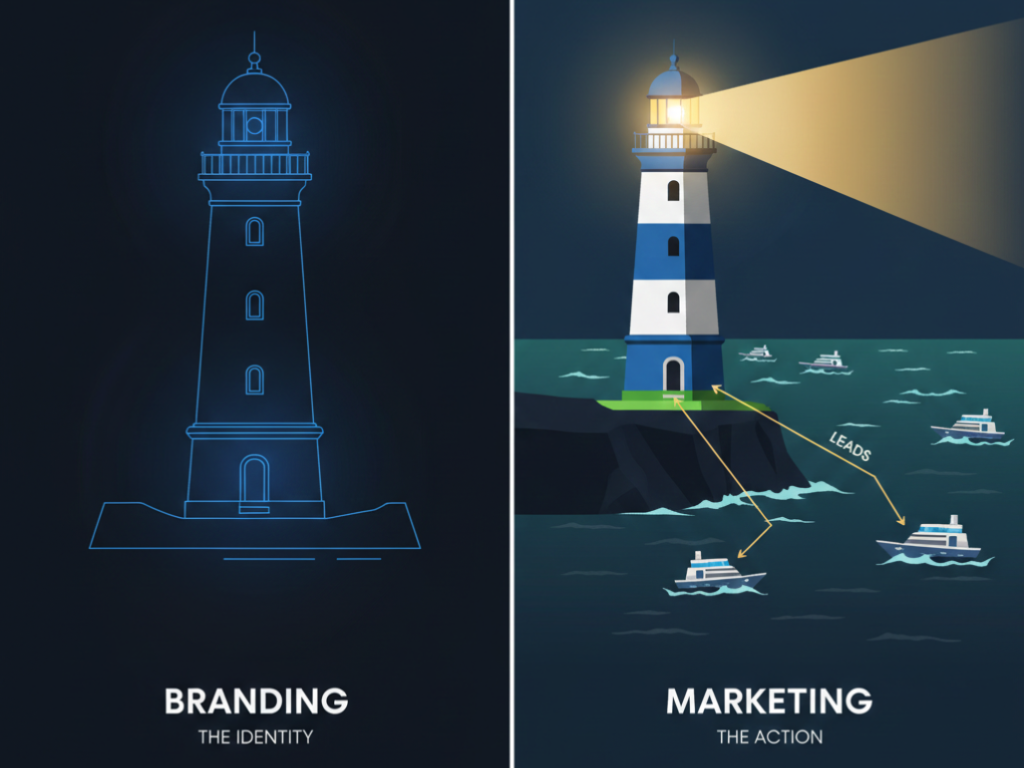
The sad truth is that businesses often treat "branding" and "marketing" as interchangeable terms. However, understanding the nuances of branding vs marketing is the difference between a company that merely survives and a company that dominates its market. At Quill Marketing, we see many organizations pour thousands of dollars into campaigns only to see diminishing returns because they failed to establish a foundation first.
In this guide, we will break down the fundamental differences between these two pillars, why they must work in harmony, and how to identify exactly which one your business needs right now to scale effectively.
To understand the relationship between these two, it is helpful to think of branding as the "who" and marketing as the "how."
Branding is your identity. It is the soul of your company, the values you stand for, and the gut feeling someone has when they hear your name. It is permanent and internal. Marketing, on the other hand, is the series of actions you take to bring that identity to the world. It is the tactical execution—the ads, the emails, and the social media posts.
When you look at branding strategy vs marketing strategy, the timeline is the biggest differentiator. A branding strategy is a long-term play designed to build loyalty and recognition. A marketing strategy is often short-term or seasonal and designed to drive a specific action, like a sale or a lead.
Before you can market effectively, you must define a brand strategy for your specific organization. It is not just a logo or a color palette. A true brand strategy is a comprehensive plan that outlines how you will build a relationship with your audience. It includes your mission statement, your brand promise, and your competitive advantage.
Without this strategy, your marketing becomes "noisy." You might get clicks, but you won't get fans. A well-defined brand strategy acts as a filter for your marketing team; it tells them what kind of language to use, what kind of imagery to select, and even which platforms are worth their time.
Once you know who you are, you need to know where you sit in the market. A brand positioning strategy is the process of carving out a unique space that no one else can fill. Are you the luxury option? The affordable alternative? The innovator?
Proper positioning ensures that when you do start your marketing efforts, you aren't competing solely on price. When you have successfully positioned your brand, your audience understands your value before they even see a price tag. This makes the marketing job significantly easier because the "why" is already established.
How you speak to your audience is just as important as where you find them. A brand messaging strategy creates a consistent "voice" for your business. Whether a customer reads an organic blog post on your site or clicks a paid Google Ad, the tone should feel identical.
Consistency builds trust. If your marketing sounds like a different person every week, your audience will feel a sense of subconscious friction. They will experience dissonance.
Clear messaging ensures that your brand’s personality is reinforced with every single touchpoint, turning a one-time visitor into a long-term lead.
One of the most common mistakes we see is marketing without brand strategy implementation. This usually happens when a business is desperate for immediate leads. They launch aggressive ad campaigns, offer deep discounts, and chase every digital trend.
While this might produce a temporary spike in sales, it is ultimately unsustainable. Marketing without a brand is like building a house on sand. You have to keep spending more and more money to get the same results because you aren't building any "brand equity." People buy because of the discount, not because of the company. The moment the discount disappears, so does the customer.
Many entrepreneurs assume that branding is only for companies like Apple or Nike. However, branding for small businesses is actually more critical than it is for large corporations. A small business does not have a multi-million dollar ad budget to force its way into people's minds.
For a smaller entity, your brand is your "moat." It is the reason a local customer chooses you over a massive national competitor. By having a clear identity and a local "soul," you can outmaneuver larger companies that feel cold or corporate. Branding allows you to compete on personality and trust, which are two things a large budget cannot buy.
How do you know when you need branding instead of more marketing? Here are a few signs that your brand needs work:
If these sound familiar, more marketing isn't the answer. You need to take a step back and refine your brand foundation. Once the brand is healthy, the marketing will naturally become more efficient.
At the end of the day, the goal of branding vs marketing is the same: to grow the business. However, they achieve this goal in different ways. Marketing "pushes" your product toward the customer. Branding "pulls" the customer toward your product.
When both are working together, you create a powerful growth engine. Your branding makes people trust you, and your marketing gives them a way to act on that trust. This synergy leads to a lower cost per lead, higher customer lifetime value, and a more resilient business that can survive shifts in the economy or changes in search algorithms.
At Quill Marketing, we don't just "run ads." We specialize in helping businesses find the perfect balance between identity and execution. We understand that a successful branding strategy vs marketing strategy isn't an "either/or" choice—it’s an "and."
Our team works with you to identify your unique positioning and voice before we ever spend a dollar on media. This ensures that every piece of content we create and every ad we place is rooted in a deep understanding of your brand's core values. We help you move away from the "spray and pray" approach of marketing without brand strategy and toward a focused, high-intent growth plan.
Whether you are a startup looking for your first brand positioning strategy or an established company that needs to modernize its brand messaging strategy, we have the tools to make it happen.
Marketing is the fuel, but branding is the engine. If you try to pour fuel on the ground, nothing happens. But when you pour it into a finely tuned engine, you can go anywhere.
Invest the time to define your brand. Understand your audience, perfect your message, and stand for something. Once you have that foundation, your marketing will not only work better—it will work for years to come.
Ready to build a brand that converts? Contact Quill Marketing today. Let’s stop just "marketing" and start building a legacy.