.png)
Email Now: hello@quillmarketing.com

Email Now: hello@quillmarketing.com
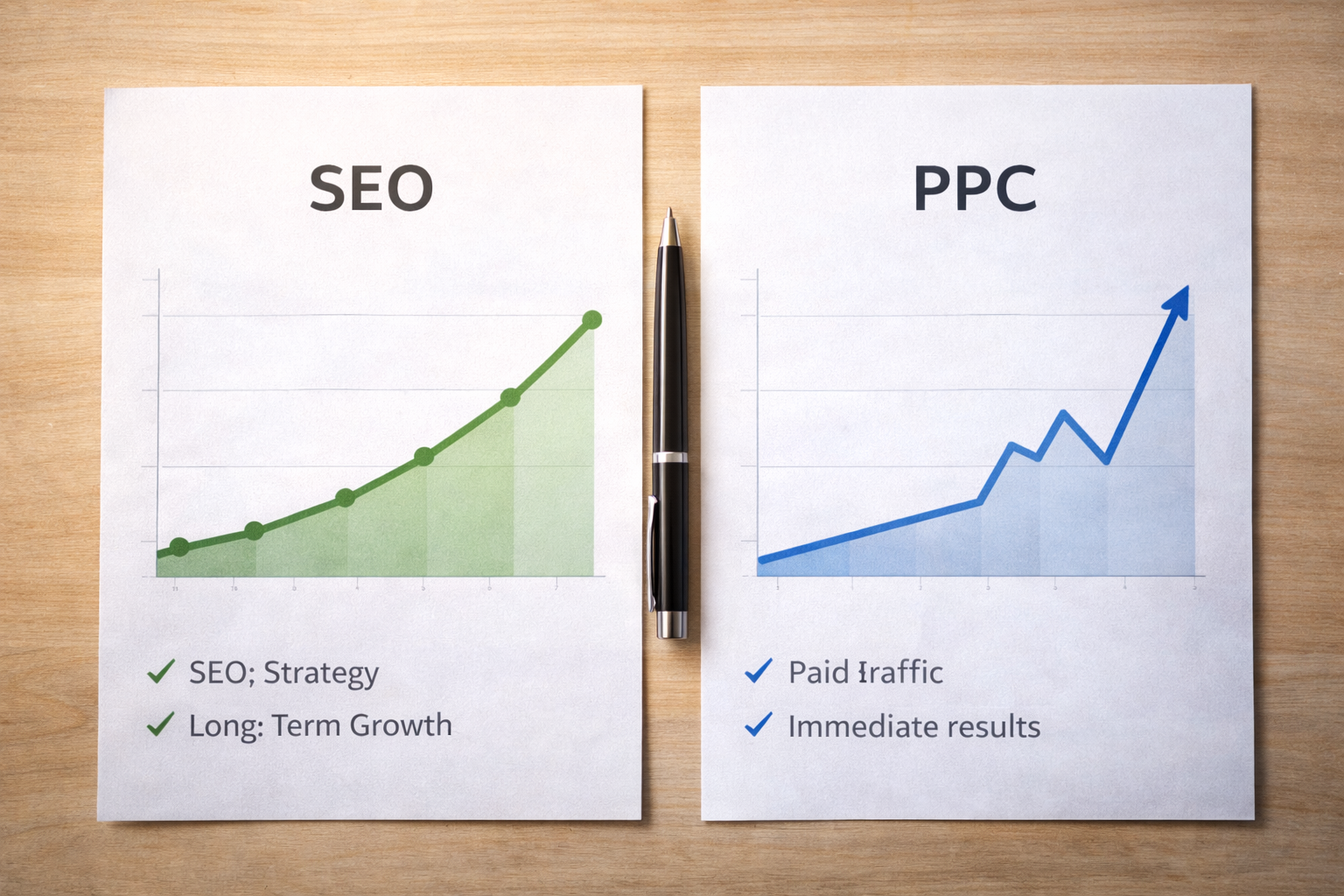
Choosing between a long-term organic strategy and immediate paid visibility is one of the most common dilemmas for business owners. When you look at SEO vs PPC, you are essentially comparing two different philosophies of growth. One is about building a permanent digital asset that generates value over time, while the other is about buying immediate access to a specific audience. Both are powerful, but they serve different roles in your lead generation funnel.
For a new business, the pressure to produce revenue quickly often makes the choice feel urgent. However, a balanced marketing mix is usually the most resilient path forward. By understanding how these channels interact, you can stop viewing them as rivals and start seeing them as partners. In this guide, we will break down the mechanics of SEO vs PPC so you can decide where to allocate your marketing budget for the best results. We will explore the speed of execution, the long-term cost efficiencies, and how to maintain a steady flow of high-quality leads regardless of market fluctuations.
Before we dive into the lead generation potential, let's define the terms. Search Engine Optimization (SEO) involves improving your website to rank naturally in organic search results. It is a multifaceted process that includes content creation, technical fixes, and building authority through backlinks.
On the other hand, Pay-Per-Click (PPC) is a model where you pay a fee each time one of your ads is clicked. The most common platform for this is Google Ads, where businesses bid on keywords to appear at the very top of the search results page. While SEO focuses on earning traffic, as we mentioned earlier, PPC focuses on buying it.
Read on to understand the respective advantages of SEO vs Google Ads.
If your primary concern is how to get leads fast, then PPC is the undisputed winner. A well-constructed PPC campaign can go live in hours. Once your ads are approved, you can immediately start appearing in front of users who are searching for your specific services. This makes it the best marketing channel for leads when you are launching a new product, running a seasonal promotion, or simply need to fill your sales pipeline immediately.
SEO, by contrast, is a slow burn. It generally takes three to six months to see significant movement in organic rankings. Because search engines need time to crawl, index, and trust your content, you cannot expect a flood of organic leads overnight. However, the leads you eventually get from SEO often have a higher level of trust because users generally perceive organic results as more "earned" than paid ones.
When comparing PPC vs SEO cost, it is helpful to think of it as "renting" versus "owning" your traffic.
For many, the question of “SEO or PPC” for small business owners basically comes down to cash flow. If you have a healthy budget but no time, PPC is great. If you have more time than money, or you want to build a sustainable lead source that doesn't require a daily payment, SEO is the superior investment.
When we look at paid search vs organic search, there is a notable difference in how users interact with the results. Statistics consistently show that the top organic results have a much higher click-through rate than paid ads. This is because many users have developed "ad blindness" and tend to trust the organic "recommendation" of Google’s algorithm more than a paid advertisement.
However, PPC lead generation has one major advantage: precision. With PPC, you can control exactly which page a user lands on and what message they see. You can target specific demographics, locations, and even the time of day. This level of control often leads to a higher conversion rate for specific, high-intent "buy now" keywords.
The debate over SEO vs PPC shouldn't really be about which one is "better," but rather which one you need right now. Most successful businesses use a hybrid approach to maximize their reach.
In a perfect world, you wouldn't choose between SEO vs PPC; you would use them together. You can use PPC to identify which keywords convert the best and then focus your SEO efforts on those high-value terms. Meanwhile, your SEO efforts will eventually lower your reliance on paid ads, creating a more stable and profitable marketing ecosystem.
By balancing the immediate power of paid search with the long-term equity of organic search, you ensure that your business stays visible today while building a fortress for tomorrow.
Ready to dominate the search results? Whether you need the immediate lead volume of a targeted PPC campaign or the long-term authority of a custom SEO strategy, Quill Marketing delivers. Don’t leave your growth to chance. Contact us today for a free strategy session and start scaling your business now!