.png)
Email Now: hello@quillmarketing.com

Email Now: hello@quillmarketing.com

A few months ago, a client asked us something that’s coming up more and more:
“Be honest — is AI search replacing SEO? Should we still be investing in this?”
That question says a lot about the moment we’re in.
There’s excitement.
There’s confusion.
And there’s a lot of noise.
If you scroll long enough, you’ll see bold claims that ChatGPT is killing Google and that rankings are about to become irrelevant.
That makes for good engagement.
It doesn’t make for good strategy.
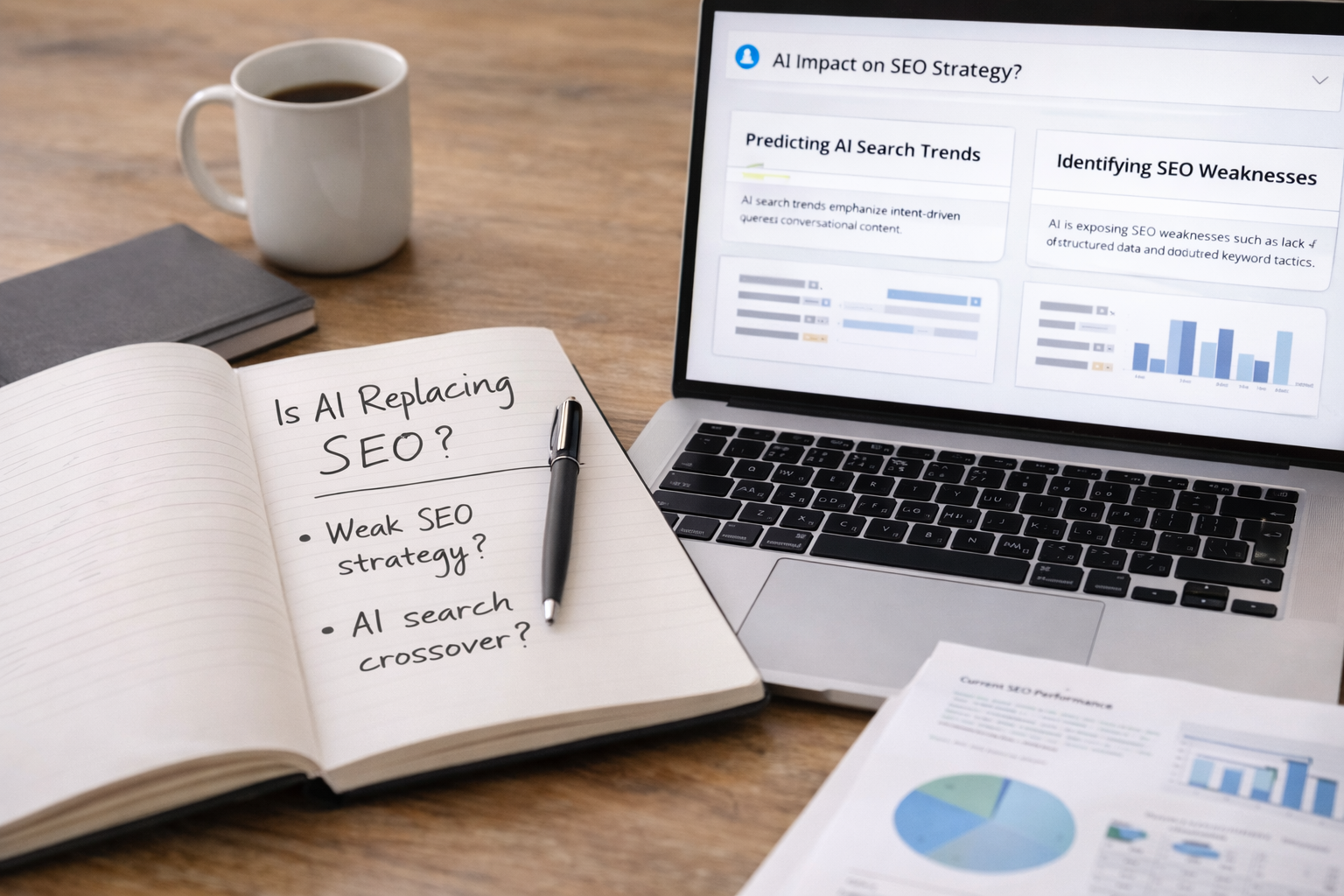
What’s happening right now isn’t the death of SEO.
It’s the exposure of weak SEO.
Buyers are absolutely changing how they research.
They’re still using Google — but they’re also asking:
Instead of clicking through ten results, they’re getting summarized answers. Condensed recommendations. Side-by-side comparisons.
That shift feels disruptive. And it is.
But here’s what’s important:
AI systems don’t create authority.
They interpret it.
They pull from indexed content, recognized brands, structured data, and established digital footprints. In other words, the same foundational elements that strong SEO has always relied on.
If your website is clear, technically sound, and topically authoritative, AI-driven search tools have something strong to work with.
If your digital presence is fragmented, shallow, or inconsistent, AI doesn’t fix that.
It amplifies it.
For years, many businesses treated SEO as a checklist:
Publish blog posts.
Add keywords.
Build a few backlinks.
But real SEO has always been about structure and clarity:
That’s exactly what AI search optimization builds on.
When someone asks an AI tool for “the best roofing company near me” or “top marketing agencies for small businesses,” the system isn’t guessing.
It’s synthesizing from:
That’s not a new rulebook.
That’s modern SEO - executed well.
This is why generative engine optimization (GEO) isn’t some magical replacement for SEO. It’s an evolution of it. A refinement. A layer that strengthens how AI systems interpret what you already publish.
The fear tends to show up when business owners notice fewer clicks from traditional search results.
They assume:
“If people aren’t clicking links the way they used to, rankings must not matter anymore.”
But rankings were never the true objective.
Visibility was.
Trust was.
Influence was.
Revenue was.
If an AI-generated summary references three providers before someone ever clicks a website, the competitive advantage hasn’t disappeared — it’s just shifted earlier in the decision process.
The real risk isn’t that AI replaces SEO.
The risk is assuming yesterday’s surface-level strategy is good enough for tomorrow’s search environment.
It’s tempting to think this shift only affects national brands or tech companies.
It doesn’t.
A homeowner asking:
“Best HVAC company near me.”
A small business owner searching:
“Top accounting firms for growing companies.”
A local contractor researching:
“How do I choose a commercial roofing provider?”
Those queries are already happening inside AI platforms.
Local businesses may feel this sooner than enterprise companies because local competition relies heavily on trust, clarity, and authority signals.
If your service pages are vague, your structure is messy, or your brand information is inconsistent across platforms, AI-driven search systems may struggle to interpret you accurately.
That’s not a scale problem.
That’s a structure problem.
There’s been a rush to “optimize for ChatGPT,” as if there’s a secret prompt trick that guarantees visibility.
There isn’t.
AI search optimization, sometimes referred to as LLM optimization or Generative Engine Optimization (GEO), isn’t about gaming a system.
It’s about strengthening the signals large language models rely on.
That includes:
When these elements are aligned, AI systems can understand what you do, who you serve, and how you compare.
It’s less about chasing a new platform.
It’s more about tightening your digital foundation.
If you strip away the hype, something positive is happening.
AI-driven search is rewarding clarity.
It favors:
In many ways, this shift is eliminating the advantage of superficial optimization.
Surface-level blog publishing without structure won’t hold up.
Disconnected service pages won’t hold up.
Thin content padded with keywords won’t hold up.
But businesses that invest in structured authority? They’re not starting over.
They’re compounding.
Instead of asking, “Is AI search replacing SEO?,” which makes it sound like a battle, a better question might be:
Is our visibility strategy built for how people research today?
Because whether someone clicks a Google result or reads an AI-generated summary, the requirement underneath hasn’t changed.
Your business needs to be:
Clear.
Structured.
Authoritative.
Easy to interpret.
The platforms are evolving.
The fundamentals aren’t.
AI isn’t replacing SEO.
It’s exposing whether your strategy was built to last.