.png)
Email Now: hello@quillmarketing.com

Email Now: hello@quillmarketing.com

Ask ten business owners about AI content and you will hear two stories. In one, blog output doubled and search rankings followed. In the other, visibility slid after the site leaned on automation. Both are true, because the tool does not decide the outcome. The process around it does. The real differentiator is whether a team treats AI marketing tools as a shortcut or as one part of a thoughtful workflow. Used with judgment, AI content marketing saves serious time without putting your search visibility at risk. Here is what the research shows, and how to stay on the right side of it.
No, and Google has said so directly. The Google AI content guidelines state that content quality is rewarded “however it is produced.” What gets judged is whether a page is helpful, original, and trustworthy. The origin of the draft is not the issue.
The data backs this up. In 2025, Ahrefs analyzed 600,000 pages ranking in Google's top 20 and found the correlation between AI usage and position was 0.011, effectively zero. Only 13.5 percent of those pages were fully human written. For AI-generated content SEO, that is a meaningful finding: the AI origin of a piece does not hurt search rankings on its own.
What Google does punish is publishing piles of low-value pages to manipulate rankings. Its spam policies call this scaled content abuse, and it applies whether a person or a program did the writing. The risk was never the tool. The risk is volume without value.
It says AI helps most when a person stays involved. A 2023 experiment published in Science gave writing tasks to 453 working professionals. The half using ChatGPT finished about 40 percent faster, and graders rated their output 18 percent higher.
The catch is documented just as clearly. A Stanford team audited popular AI search tools and found that only about half of their sentences were fully supported by the sources they cited. These systems write with total confidence whether they are right or wrong. That is a manageable flaw in a draft, and a serious liability in a published article carrying your company's name.
This is why human-edited content consistently outperforms raw AI output. Google's quality evaluators are trained to reward what the company calls E-E-A-T: experience, expertise, authoritativeness, and trustworthiness. A draft that has never been touched by a knowledgeable person rarely scores well on any of those four signals.
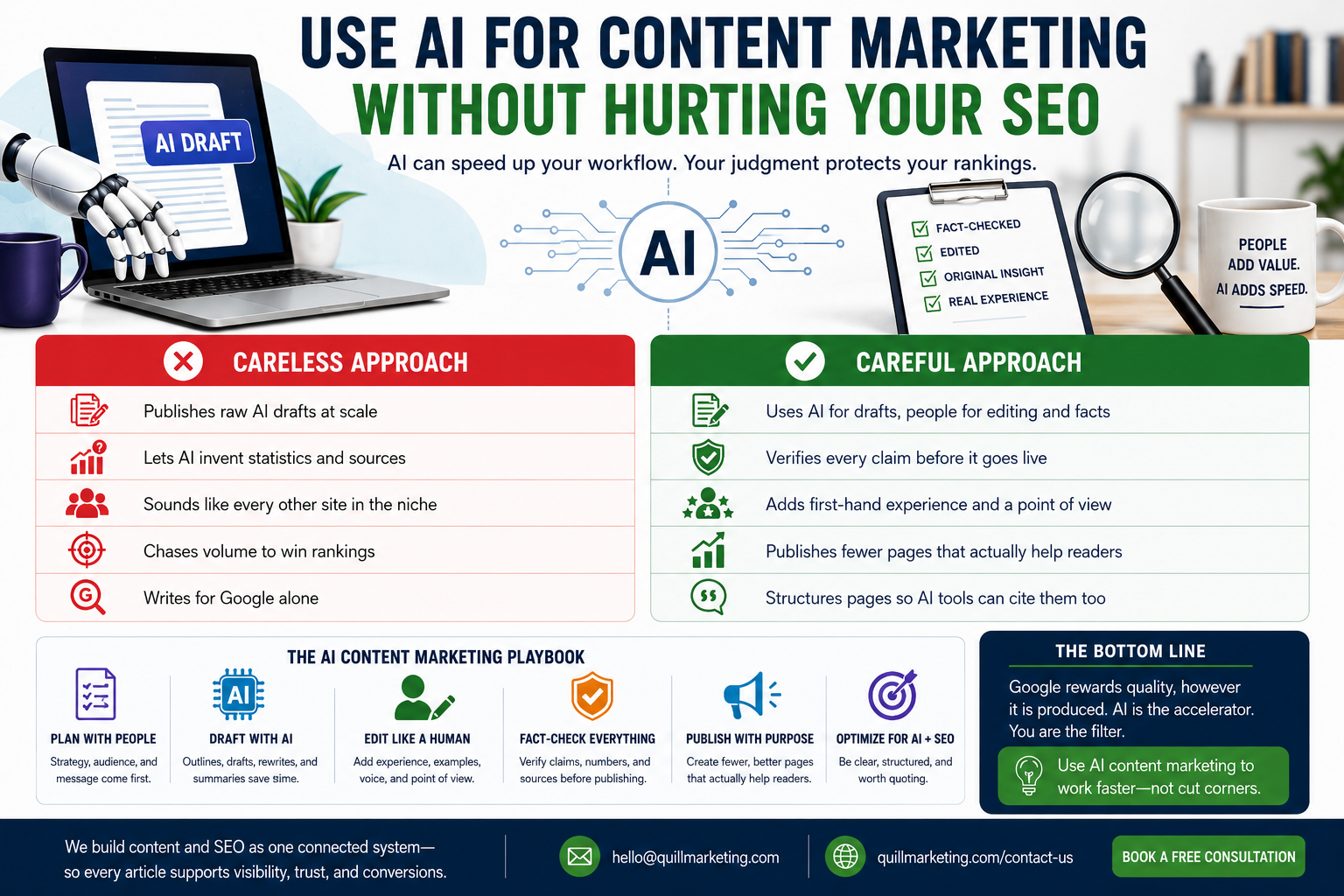
The playbook writes itself. Let AI speed up the work. Never let it have the final word.
In the middle of it. A sound AI content strategy puts humans in charge of the decisions that require judgment: what to write, what angle to take, and whether the finished piece is accurate and worth publishing. Between those decisions, AI for content creation handles the work that burns time without requiring expertise:
What AI cannot supply is the ingredient Google's quality guidelines keep pointing to: evidence of real experience. Your examples, your numbers, your take on the trade-offs. That layer comes from people, and it is the difference between a page worth citing and a page worth skipping. Treat AI content marketing as an assembly line with a person at both ends, and you get the speed without the damage.
A short list of habits causes most of the wrecks:
None of these mistakes require AI. They are failures of care, and they sink human-written sites too. AI just makes them cheap to commit at scale. In AI content marketing, the human review pass is the cheapest insurance you can buy.
More closely than most people realize. The connection between AI and SEO runs in both directions. Good SEO habits, including clear structure, cited sources, and direct answers, now also determine whether AI assistants pick up and quote your content. More customers get recommendations from ChatGPT, Perplexity, and Google's AI Overviews, and those tools build answers from content they can lift cleanly.
Researchers at Princeton and other universities tested this in a 2024 study. Pages that cited sources, included quotable statements, and used concrete statistics became up to 40 percent more visible in AI-generated answers. Old tricks like keyword stuffing performed worse than doing nothing.
This practice is called generative engine optimization, or GEO, and it rewards habits that are worth building anyway:
A complete AI content marketing strategy treats Google and the AI assistants as two audiences reading the same page. Serve both, and algorithm updates get much less scary.
Can readers tell when an article was written by AI?
Often, yes. Unedited AI writing tends to be generic, evenly paced, and light on specific examples, and readers pick up on it. A real editing pass that adds detail and a distinct voice removes the tell. Human-edited content also performs better on the E-E-A-T signals that Google's quality evaluators look for.
Do AI detection tools matter for search rankings?
Not directly. Google evaluates whether content is helpful and original, not which tool produced it, and detectors deal in probabilities rather than proof. Build quality control around editing and fact checking, not detector scores.
What should a basic AI content strategy include?
At minimum: a human deciding what to write and why, AI handling drafts and content optimization tasks, and a qualified editor reviewing every piece before it goes live. The strategy also needs clear guidelines on fact checking, source linking, and author attribution, especially for any health or finance topics where Google's scrutiny is higher.
What is GEO, and is it different from SEO?
GEO stands for generative engine optimization, the practice of getting your business cited in answers from tools like ChatGPT and Google's AI features. It builds on SEO rather than replacing it. Clear, well-sourced, well-structured content tends to win in both systems.
Getting this balance right is the work we do at Quill Marketing. We build content and SEO as one connected system, so every article supports visibility, trust, and conversions instead of sitting in isolation. Email us at hello@quillmarketing.com or visit quillmarketing.com/contact-us to book a free consultation.